

Beyond Memory
Hope for the Future of Dementia Care
For many families, caring for a loved one with Alzheimer’s or dementia can feel overwhelming. The team at Cambridge Caregivers sees those challenges every day.
But there is also reason for hope. Researchers are making progress toward earlier diagnosis, better prevention and more effective treatments, while community leaders are advancing support for people living with brain change and their families.
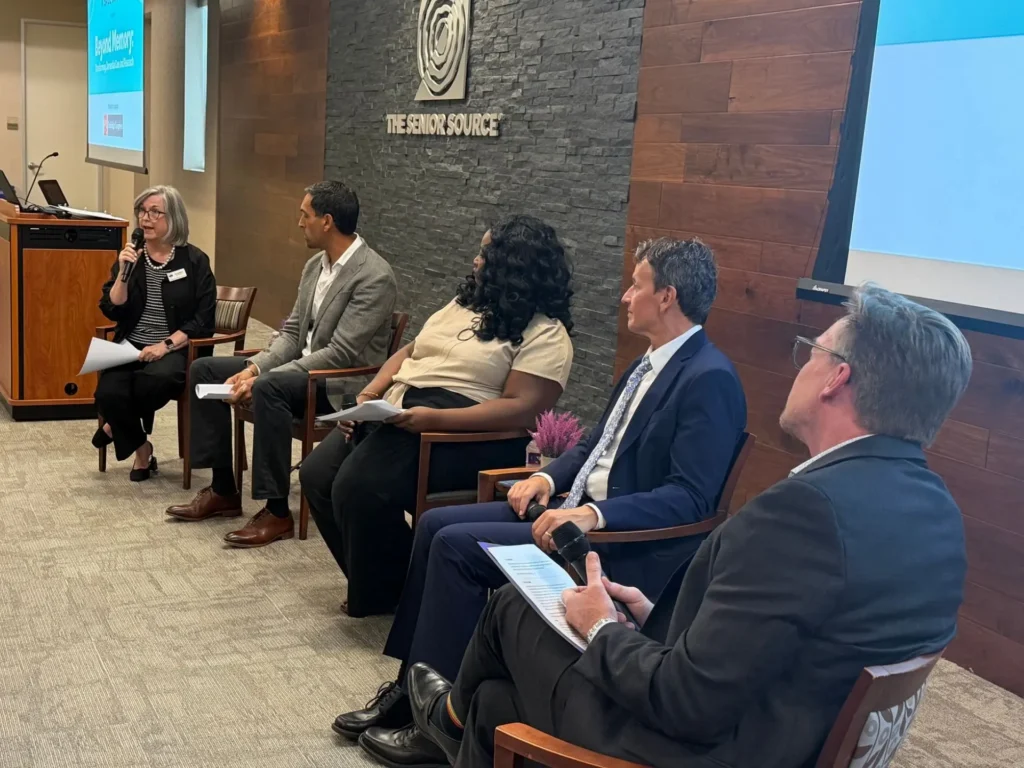
Cambridge Caregivers recently brought those perspectives together as sponsor of “Beyond Memory: Transforming Dementia Care and Research,” a panel discussion at The Senior Source. Part of the Sage Society Conversations series, the program brought together experts in clinical care and research with leaders in dementia and caregiver support.
Ernie Cote, Chief Operating Officer of Cambridge Caregivers, moderated the program and shared why the topic is personal as well as professional.
“As an only child, I was sole caregiver for my mother as she experienced rapid cognitive decline due to a brain tumor, and later, for my grandfather, when he was diagnosed with dementia,” he said. “My hope is that my children won’t experience that with me.”
Cote opened the discussion with Brendan Kelley, MD, Clinical Vice Chair, Department of Neurology, UT Southwestern Medical Center.
“Your research suggests that, as we get better at detecting Alzheimer’s-related changes earlier, we could eventually reach a point where we’re treating Alzheimer’s more like a chronic disease that we manage over time, rather than waiting for dementia to become obvious,” Cote said. “What are less obvious signs we should be looking?”
Memory loss and repeating questions or stories are well-known symptoms. “But there are other symptoms early on that might clue you in that the person is experiencing cognitive decline,” Kelley said. “Some of them are difficult for us as clinicians to define, such as subtle changes in personality, or a loss of the zest for the things the patient is normally interested in.”
Others may include anxiety, depression or increased difficulty finding words, which can also be part of normal aging. These aren’t hard-and-fast indicators of dementia but may warrant an evaluation – preferably sooner rather than later.
“Often we can be more effective with our current treatments if we identify people early on,” Kelley said. “We now have a biological test that we can do to confirm a diagnosis, so that’s all the more reason to bring those symptoms to the attention of a primary care physician.”
Kelley also pointed to medications introduced in recent years that can slow the progression of dementia.
“Are these new medications perfect? No,” he said. “Are they a huge first step? Absolutely. For the first time, we can now say that we can offer a treatment that can impact what’s going on.”
Researchers are also working to better understand who develops dementia – and why. While many people assume dementia risk is largely genetic, research paints a more complex picture. Cote asked Gagan S. Wig, PhD, Professor and Director of Cognitive Neuroscience at the Center for Vital Longevity at UT Dallas, to summarize his team’s research.
“As people age, changes occur in the networks of the brain, which enable different parts of the brain to function together,” Wig said. “But there’s a lot of variability in how the brain changes over the lifespan. Not everybody follows the same trajectory. Different people have different patterns. We’ve been trying to understand some of those differences.”
Wig noted that individuals of lower economic or lower education levels seem to have greater risk of dementia.
“But that doesn’t mean that having a college degree or certain income prevents dementia,” he said. “It tells us that there’s something about our environments that confers risk, and that’s independent of genetics.”
His team is studying potentially modifiable factors, including sleep, exercise, social connections and mental stimulation. Ultimately, the research may lead to more individualized prevention strategies tailored to each person’s risk profile.
Living better with dementia
Advances in science may change the future of dementia care. But families don’t have to wait for the next breakthrough to make life better today. Knowledge, community support and compassionate care can make a difference now.
Kimberly Knight, Director of Caregiver Support Programs at The Senior Source, emphasized the enormous load many family caregivers carry.
“Caregivers are overwhelmed,” she said. “Typically, the primary caregiver wears so many hats – managing a home, finances, healthcare, all while caring for a loved one with dementia. The caregiver’s needs tend to go out the window.”
The toll can be significant. Many caregivers experience depression and “anticipatory grief” – painful feelings of loss as they watch loved ones decline. Knight’s advice: “Don’t do this alone. You can’t do this alone. Many people don’t know that there are resources available out there.”
Ann McKinley, Co-Founder of Dementia Friendly Dallas, focused on another powerful tool: education.
She first saw the need for education when her own mother was diagnosed.
“When my mother was diagnosed, I thought, ‘If I just told her the right facts, that would help her,’” she said. “But that’s not how it works. You don’t argue, criticize or correct. You have to go where they are. You let them lead the conversation.”
McKinley’s organization is working to encourage individuals as well as businesses and organizations to support people with dementia. Programs like Dementia Friends share best practices for communication as well as the differences between healthy aging and the signs and symptoms of dementia.
“It starts with the basic belief that people with dementia should be treated with dignity and respect,” she said.