

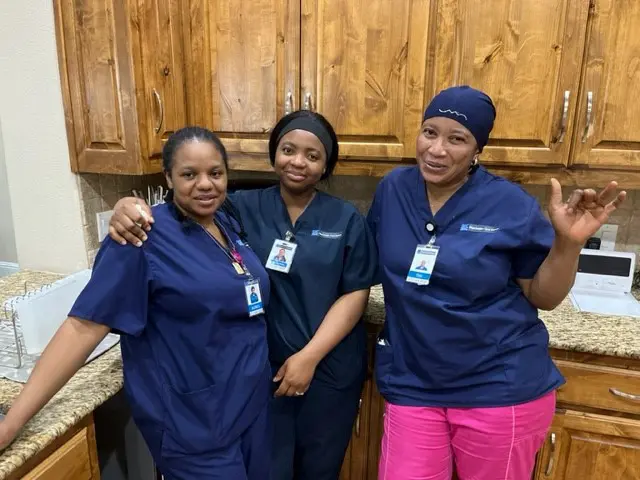
A Day in the Life at Cambridge Caregivers
There’s no such thing as a typical day at Cambridge Caregivers.
Every day brings new and sometimes unexpected challenges. Most days, that means providing hands-on assistance with daily activities. Some days, it means pivoting at a moment’s notice.
Here’s a glimpse of the many different situations Cambridge Caregivers encounter. We’ve compressed the timeline into a single day, but every example is drawn from real experiences. Some client details have been changed to protect privacy.
9 a.m. — An Unexpected Funeral
In Houston, caregiver Jackeline gets an unexpected request. A couple she regularly cares for needs to travel to New Orleans. The husband’s brother has died, and the funeral is less than 48 hours away. The husband has mobility challenges, while his wife is living with brain change and needs assistance with daily activities. Their adult children live out of state and can’t arrange the trip on such short notice.
The client asks: Can Jackeline accompany them? After quickly arranging care for her own children, Jackeline drives the couple to New Orleans. She’ll stay with them for nearly three days, helping them navigate the funeral and family gatherings.
Before returning to Houston, Jackeline will make one more stop: the husband’s childhood home, where he reminisces about his early years. She records his memories to share with the family. A sad occasion becomes an opportunity to preserve precious family memories — thanks to a caregiver willing to go the extra mile.
11:10 a.m. — A Transition to Hospice
A longtime client’s wife calls with an update: Her husband has just begun receiving hospice care. His needs are changing. He now requires more hands-on assistance with daily activities, including help transferring from his bed to a wheelchair. The family hopes that Cambridge Caregiver Elizabeth, who has been helping him for months, can continue to provide care.
After reviewing the updated care plan, a Scheduler confirms that Elizabeth has the training and skills needed. The hospice team will manage his medical care, including pain and symptom management, while Elizabeth continues to provide personal care, companionship and support with daily routines.
The family is grateful that Elizabeth will continue to provide a steady, reassuring presence during an emotional time.
1:30 p.m. — Just Hanging Out
Across town, caregiver Taj is taking his client, whom we’ll call Robert, to a nearby mall. It’s a way to combine some light exercise with a fun outing. As the two stroll through the mall, laughing and trading jokes, Taj runs into an old friend.
“Are you working? Or are you just hanging out?” the friend asks.
“Well, both,” Taj replies with a smile. “I’m working — but Robert is my buddy. We’re getting some exercise and just enjoying ourselves.”
Robert has some mild mobility challenges, and his busy family wants to make sure he stays active, engaged and safe. But what started as a practical arrangement for transportation and companionship has blossomed into a genuine friendship.
It’s a perfect example of companion care at Cambridge Caregivers. Sometimes, the best care looks a lot like two friends just hanging out.
2:35 p.m. — Going the Extra Mile
Not all Cambridge caregivers work in clients’ homes. At an assisted living community, caregiver Marilyn is preparing lunch for a client we’ll call Carol, who is living with advanced dementia. Carol often has little appetite for meals prepared by the facility, so Marilyn has learned to prepare foods she enjoys. It’s one of many ways Marilyn adapts her care to Carol’s changing needs.
Later in the day, when Carol experiences sundowning — increased confusion and agitation that can affect people living with brain change — Marilyn provides a calm, reassuring presence. Marilyn approaches each day with patience and creativity, finding ways to meet Carol’s needs while preserving her dignity.
Over time, the two have developed a close bond that’s evident to the assisted living staff. It’s a reminder that exceptional caregiving isn’t just about following a care plan. It’s about knowing the person, recognizing what works and adapting when it doesn’t.
4:30 p.m. — Knowing When Something Isn’t Right
In Dallas, caregiver Frances, a certified nursing assistant, is caring for a client we’ll call Miss M. Frances knows Miss M. well — her routines, personality and usual health patterns. So when Miss M. seems unusually tired, Frances notices.
As part of her regular routine, Frances checks Miss M.’s blood pressure and blood oxygen levels. Both are significantly lower than normal.
Miss M. insists she’s fine, aside from fatigue and mild nausea. But Frances is concerned enough to contact her daughter, who calls 911. At the hospital, doctors discover blood clots in Miss M.’s lungs — a potentially life-threatening pulmonary embolism. Treatment begins promptly, and Miss M. eventually returns home to recover.
“I feel like Frances saved my mom’s life,” her daughter later tells Cindy Greenberg, Community Liaison in Cambridge Caregivers’ Dallas office.
It’s a powerful example of the value of continuity of care. Because Frances knows her client so well, she recognizes a subtle change that might otherwise have gone unnoticed.
Every Day Is Different
By 5 p.m., Cambridge caregivers have helped a couple attend a funeral, supported a family through a hospice transition, provided transportation and friendship, offered extra attention in assisted living and recognized a potentially life-threatening emergency.
Tomorrow will bring a different set of challenges.
Concierge-level caregiving involves more than a checklist of tasks. It takes flexibility, sensitivity, good judgment, compassion and the ability to respond when plans change.
We’re proud of the members of the Cambridge Caregivers team who bring those qualities to work every day — whatever the day may bring.